28 October 2026 — Secure House Admin
Home Security Shutters: How They Improve Protection for Residential Properties
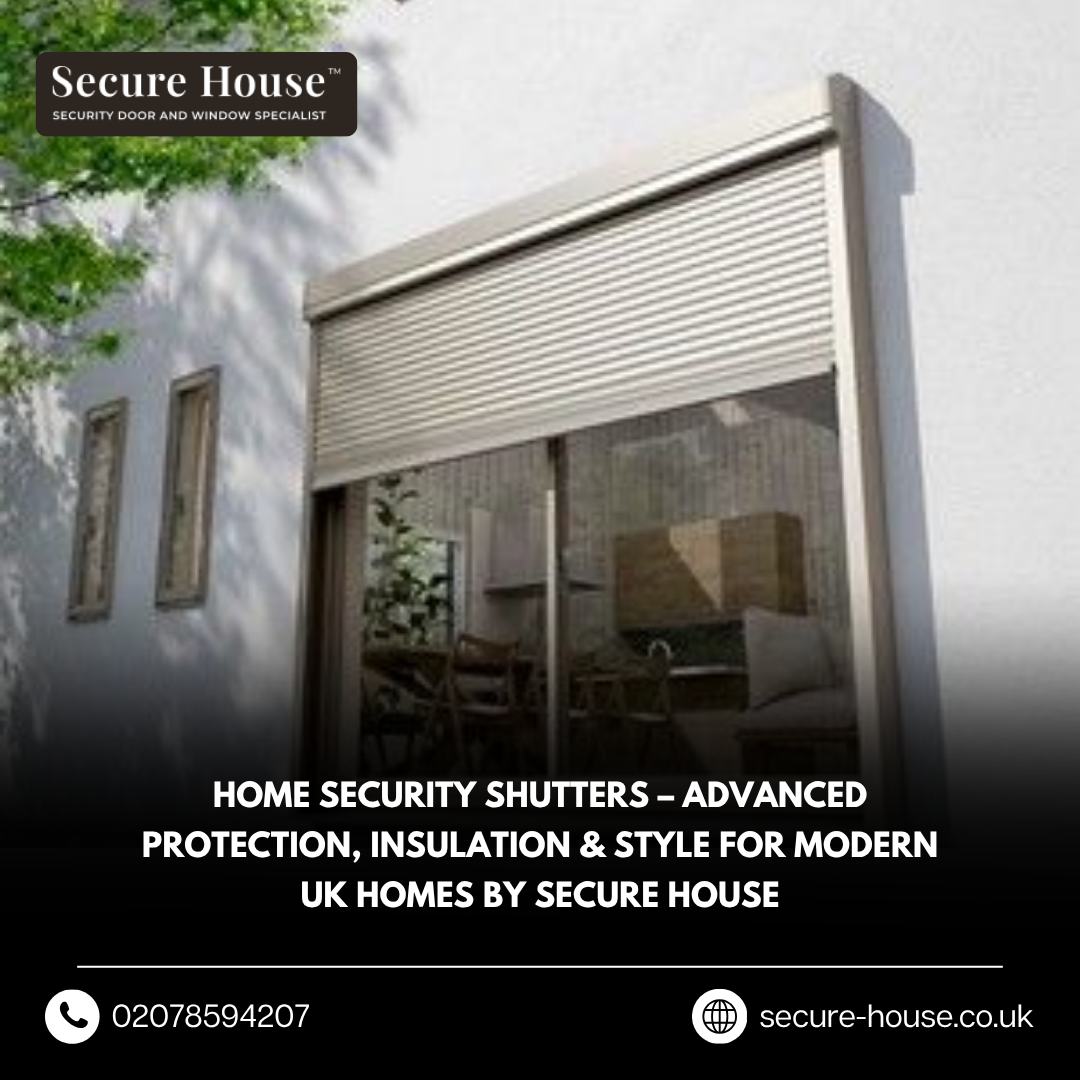
Home security shutters are rolling or folding barriers fitted over windows, glazed doors and other openings to make forced entry slower, noisier and harder. Closed, they stand between an intruder and the most common point of attack on many homes, the glass. They also bring privacy, light control and some thermal and sound benefits, which is why many owners treat them as part of the home rather than just an add-on.
This guide explains how shutters work, the main types, what ratings mean, where they make most difference and what to check before fitting them to a house or flat.
What are home security shutters and how do they work?
Home security shutters are shutter systems made from interlocking slats, usually aluminum, that run in side guide rails and roll up into a box above the opening. When closed, the slats and rails form a continuous physical barrier in front of the glass and frame. They can be operated by hand or by a motor.
The same technology is used on many commercial buildings, but residential security shutters are usually specified with a stronger focus on appearance, quiet operation and colour matching. Secure House describes its shutters as available with a range of colours for side rails, housing and slats.
How do house security shutters improve protection?
House security shutters improve protection by adding a second physical barrier in front of vulnerable openings, so an intruder must defeat the shutter before reaching the glass or frame. This has three effects:
Delay: a rated shutter takes time and effort to defeat, and time is the main enemy of an opportunist.
Noise and visibility: forcing a shutter is slower and noisier than breaking a window, which raises the chance of being noticed.
Deterrence: visible shutters signal that the property is protected and make it less attractive than easier targets.
Shutters work only when they are closed. A set left open all day offers no protection, which is why timers and remote or smart controls are a practical advantage. They also do not replace a good door, locks, lighting or an alarm. They add a layer rather than solve every weakness.
What types of residential security shutters are available?
The two main types are roller shutters and collapsible grilles. Secure House groups them under its grilles and shutters range.
Option
How it works
Best suited to
Points to check
Roller shutters
Slats roll into a box above the opening
Windows, patio doors and garage openings where a solid barrier is wanted
Box position (top-mounted, lintel or concealed), rating, motor type
Collapsible grilles
Folding grille that retracts to the side
Entrances and openings where visibility and airflow matter
Rating, track design, retraction space
Secure House states that its security shutters are rated up to RC3 and offered with minimal box designs, top-mounted and lintel systems, and fully covered box designs. It states that its grilles are rated up to SR4, with retractable track and swivel return options, for domestic and commercial use.
Manual or motorized?
Manual operation by hand-crank or strap is the simplest and most economical option, but it becomes tiring on large or numerous shutters. Motorized operation can use a key switch, wall switch, remote control, timer or wireless control, and some systems link into home automation. Ask what happens in a power cut and whether a manual override is provided.
What do shutter security ratings mean?
A rating tells you how an assembly performed in a defined test, and it only applies to the tested configuration. Secure House refers to RC3 for its roller shutters, which relates to the burglar-resistance classes in EN 1627. For one community centre project it also refers to an SR2 rating under LPS 1175, a separate scheme often requested by insurers, councils and construction firms for commercial buildings. When you receive a quote, ask which standard applies, which class, and for a certificate covering the exact shutter, guide rails and fixings.
Where do shutters make the most difference?
Shutters are most useful on openings that are easiest to attack or hardest to see:
Ground-floor windows, especially at the rear or side of a property.
Patio and French doors with large areas of glass.
Conservatory or extension glazing where permitted.
Garage openings, where roller doors and shutters share similar systems. See Secure House's garage doors for related options.
Basement windows and light wells.
If you are also upgrading glazing, Secure House offers security windows that can be planned alongside shutters.
Do shutters offer other benefits?
Yes, though security should remain the main reason to fit them. Secure House notes that closed shutters trap a layer of air against the glass, which can reduce heat loss in winter and heat gain in summer. They also reduce light, useful in bedrooms and media rooms, and can reduce outside noise. Shutters can improve comfort, but they are not a substitute for proper insulation, and results depend on the glazing and installation.
What should you check before fitting security shutters?
Several practical points apply to all security shutters:
Emergency escape: bedroom windows are often escape routes. Shutters on them must open easily from the inside, including during a power cut.
Planning and consent: external shutters may need planning permission or listed building consent in some locations, and leaseholders usually need the freeholder's permission.
Insurance: tell your insurer and ask whether a certified shutter affects your cover.
Fixing surfaces: the wall or frame must be strong enough to hold the guide rails and box.
Appearance: check box size, colour and finish against the building style.
Maintenance: guide rails and motors should be checked and cleaned regularly.
Common mistakes with domestic security shutters
Choosing a shutter with no stated rating, then assuming it matches a certified product.
Fitting shutters but leaving the door or a weak side window unprotected.
Forgetting that open shutters do nothing, and not using timers or reminders.
Blocking escape routes from bedrooms.
Overlooking planning, lease or listing restrictions until after the order.
Homeowners searching for domestic security shutters UK products should compare ratings and certificates, not only appearance, and should see examples of completed installations. Secure House shows some of its finished work on the projects page.
Frequently Asked Questions
Do home security shutters stop burglars?
They make entry slower, noisier and harder, and rated shutters are tested for forced-entry resistance. They do not make a property impossible to break into, so they work best alongside good doors, locks and an alarm.
What is the difference between security shutters and ordinary shutters?
Security shutters are built from stronger slats, guide rails and fixings, and are tested or rated for resistance to attack. Ordinary shutters mainly provide shade, privacy or weather protection.
Can security shutters be fitted to existing windows?
Often yes. Shutters can be added to existing buildings as well as designed into new builds, provided the structure can support them and there is space for the box and guide rails.
Are electric shutters better than manual ones?
Electric shutters are easier to use and can run on timers, which helps ensure they are closed. Manual shutters are simpler and cheaper to maintain. Choose based on size, number of openings and how often you will use them.
What happens to motorised shutters in a power cut?
It depends on the system. Ask the supplier whether a manual override or battery backup is included, and confirm that shutters on escape windows can always be opened from inside.