28 October 2026 — Secure House Admin
High Security Doors for UK Homes: How to Choose the Right Level of Protection
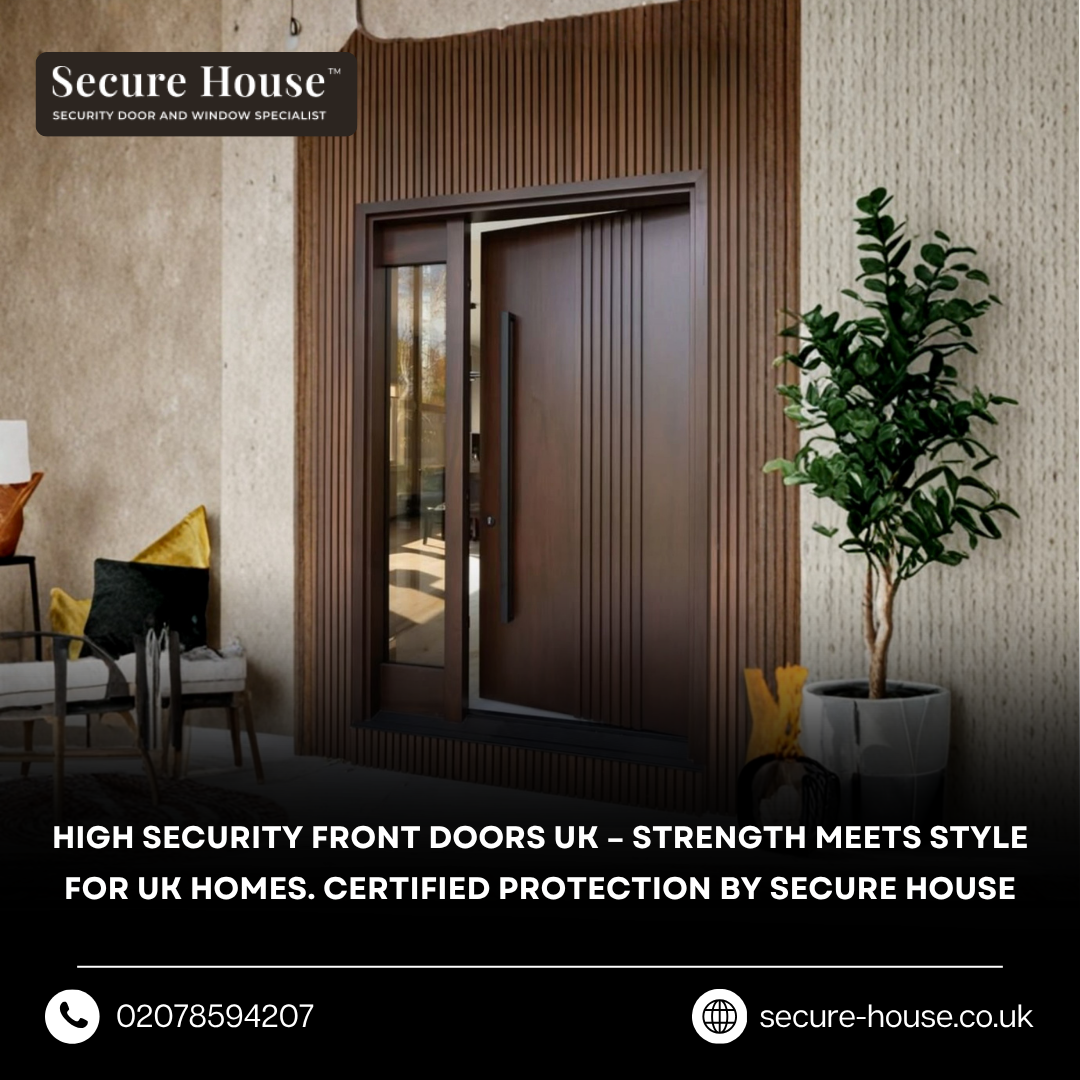
High security doors are entrance doors designed and tested to resist forced entry for longer than a standard door. They combine a reinforced frame, a solid or reinforced leaf, multi-point locking and strengthened hinges, and the better ones carry independent test certification. The right level for your home depends on how exposed the property is, what it contains and how the door is used every day.
This guide explains how security door levels work in the UK, what RC3 and RC4 ratings mean in practice, which parts of the installation matter as much as the door itself, and what to check before you buy.
What makes a door a high security door?
A high security door differs from a standard door in three ways: how it is built, how it is tested and how it locks. A standard door is designed mainly for appearance, weather protection and everyday use. Security doors are designed so that the leaf, frame, locks and hinges all resist attack, not just the lock.
Frame: a reinforced steel frame that resists being spread, cut or levered. Secure House describes frames of up to 115 mm of steel on its premium high security doors.
Leaf: a solid or reinforced core rather than a hollow or lightweight panel.
Locking: multi-point locking, with plates or inserts that resist drilling. Secure House describes a 12-point system on this range.
Hinges: reinforced hinges with protection against the door being lifted or forced from the hinge side.
Glazing: laminated or security-rated glass wherever glass is fitted.
How are security door levels rated in the UK?
The most widely used system is EN 1627, which classifies burglar resistance from RC1 to RC6. Each class represents a step up in the tools an attacker may use and in the testing applied, so the higher the class, the greater the resistance. A rated door is tested as a complete assembly, which means the classification covers the leaf, frame, locks and hardware working together rather than any single component.
PAS 24 is a separate UK specification for the enhanced security of doorsets. It is commonly used in new-build housing to demonstrate that doors meet security requirements.
Certification matters. A non-certified door may still be well made, but it has not been independently tested to a recognized class, so its resistance cannot be compared with a rated door on the same basis.
Secure House security door levels at a glance
The descriptions below follow the security levels published on the Secure House website. Always ask for the current certificate and test report for the specific door you are quoted.
Level
What Secure House states
Stated suitability
LS1
Non-certified, entry-level doors for basic protection
Premises with low to moderate burglary risk
RC3
Certified to class 3 under EN 1627:2011
Private homes, apartments and commercial buildings
RC4
Certified to class 4 under EN 1627:2011
Homes, apartments and commercial buildings, including areas prone to burglary
RC4 + FB4
RC4 with optional FB4 ballistic protection to EN 1522
Residential and commercial buildings
RC4 + FB6
RC4 with optional FB6 ballistic protection to EN 1522
Listed for military buildings
The full descriptions are on the Secure House protection levels page.
What are RC3 security doors and who are they for?
RC3 security doors are certified to class 3 of EN 1627, the level designed to resist attempts using heavier tools such as a crowbar rather than casual force alone. Secure House states that its RC3 door is built to withstand break-in attempts with heavy-duty tools, including a 70 cm crowbar, and that it was tested by the IFT Rosenheim laboratory in Germany.
For many houses and flats, RC3 security doors are a sensible balance of resistance, appearance and practicality, particularly where the main concern is opportunistic or forced-entry attempts at the front door. Secure House states that the same level of security applies whether the door opens inwards or outwards.
When do RC4 security doors make sense?
RC4 security doors are certified to class 4, one step above RC3 in tools and test severity. Secure House states that its RC4 door resists crowbars, axes, saws, steel-cutting pliers and power drills, and it positions the door for properties in areas prone to burglary.
Consider RC4 where one or more of these applies:
The property or neighboring properties have been targeted before.
The door is hidden from the road or from neighbors, which gives an intruder more time.
The building holds high-value or business-critical contents.
The property is empty for long periods.
Higher classes mean heavier doors and frames, so the wall they are fixed to must be sound. An RC4 door set in a weak opening wastes much of the extra resistance.
Do you need ballistic protection as well?
For most homes, no. Burglary resistance and ballistic resistance address different threats. Secure House offers FB4 and FB6 ballistic upgrades to its RC4 door, certified to EN 1522 according to its website, but these suit specific high-risk situations rather than typical housing.
What else affects how well a high security door performs?
The wall and frame fixings
A door is only as strong as what holds it in place. Check the condition of the brickwork or structure around the opening and how the frame will be anchored.
Locks, cylinders and hardware
Multi-point locks spread the load across the frame. Cylinders and handles should be of a standard suited to the door, and some insurers specify lock standards, so check your policy.
Glazing and side panels
Glass and side panels are common weak points. Where they are fitted, they should be rated and tested as part of the same door set.
Installation
Even a well-rated door can underperform if it is fitted badly. Professional installation, followed by regular checks of hinges, seals and locks, protects the rating in daily use.
Opening direction and escape
Think about how the door opens and how you leave in an emergency. Locking arrangements should allow quick exit from the inside without hunting for a key.
Checklist for choosing high security front doors
Use these questions when comparing high security front doors from different suppliers:
Which standard and class is the door certified to, and can the supplier provide the certificate?
Does the certificate cover the complete door set, including frame, lock and glazing?
What is the door fixed to, and has the wall been assessed?
Does your insurer have requirements for locks or door standards?
Do you also need fire resistance, thermal insulation or sound reduction?
Will the style suit the property? Secure House offers Victorian, Georgian and modern designs through its door styles range.
Who will install it, and what aftercare is available?
Common mistakes when choosing security doors
Choosing on appearance alone and assuming the label "security" means tested.
Upgrading the door but leaving a weak frame, wall or glazed panel beside it.
Paying for a higher class than the risk justifies, or settling for a non-certified door where the risk is high.
Ignoring fire escape needs, especially in flats and shared buildings.
Skipping maintenance, so hinges, seals and locks wear unnoticed.
When to ask for professional advice
A site survey is worthwhile when the opening is unusual, the building is old or you are unsure which class suits your risk. Listed buildings and conservation areas may need consent before a front door is replaced. In leasehold flats, the freeholder's permission is usually needed, and flat entrance doors often have to keep a fire rating. You can discuss options with the Secure House team through its contact page, and see examples of finished work on the projects page.
Frequently Asked Questions
What is the difference between RC3 and RC4 security doors?
RC4 security doors are certified to a higher class than RC3 security doors under EN 1627, so they are tested against more capable tools and greater effort. Secure House lists its RC3 door as resisting heavy tools including a 70 cm crowbar, and its RC4 door as also resisting axes, saws, steel-cutting pliers and power drills.
Can a door be completely burglar proof?
No. A rating describes resistance to a defined test, not immunity. Higher classes make entry slower, noisier and harder, which is why they work best alongside good locks, lighting and an alarm.
What is the difference between PAS 24 and EN 1627?
EN 1627 is a European classification that grades burglar resistance from RC1 to RC6. PAS 24 is a UK specification for the enhanced security of doorsets. Both are based on testing the complete door assembly.
Are high security doors worth it for an ordinary house?
It depends on risk. High security doors raise the effort and time needed to force an entrance, which suits homes in higher-risk areas, properties with valuable contents or entrances that are hard to see from the street.
Will a high security door lower my home insurance?
Not automatically. Insurer requirements vary, and some policies specify lock standards such as BS 3621. Ask your insurer what they require and whether a certified door affects your policy.