28 October 2026 — Secure House Admin
Bullet Proof Doors: What They Are, Where They Are Used and What to Consider
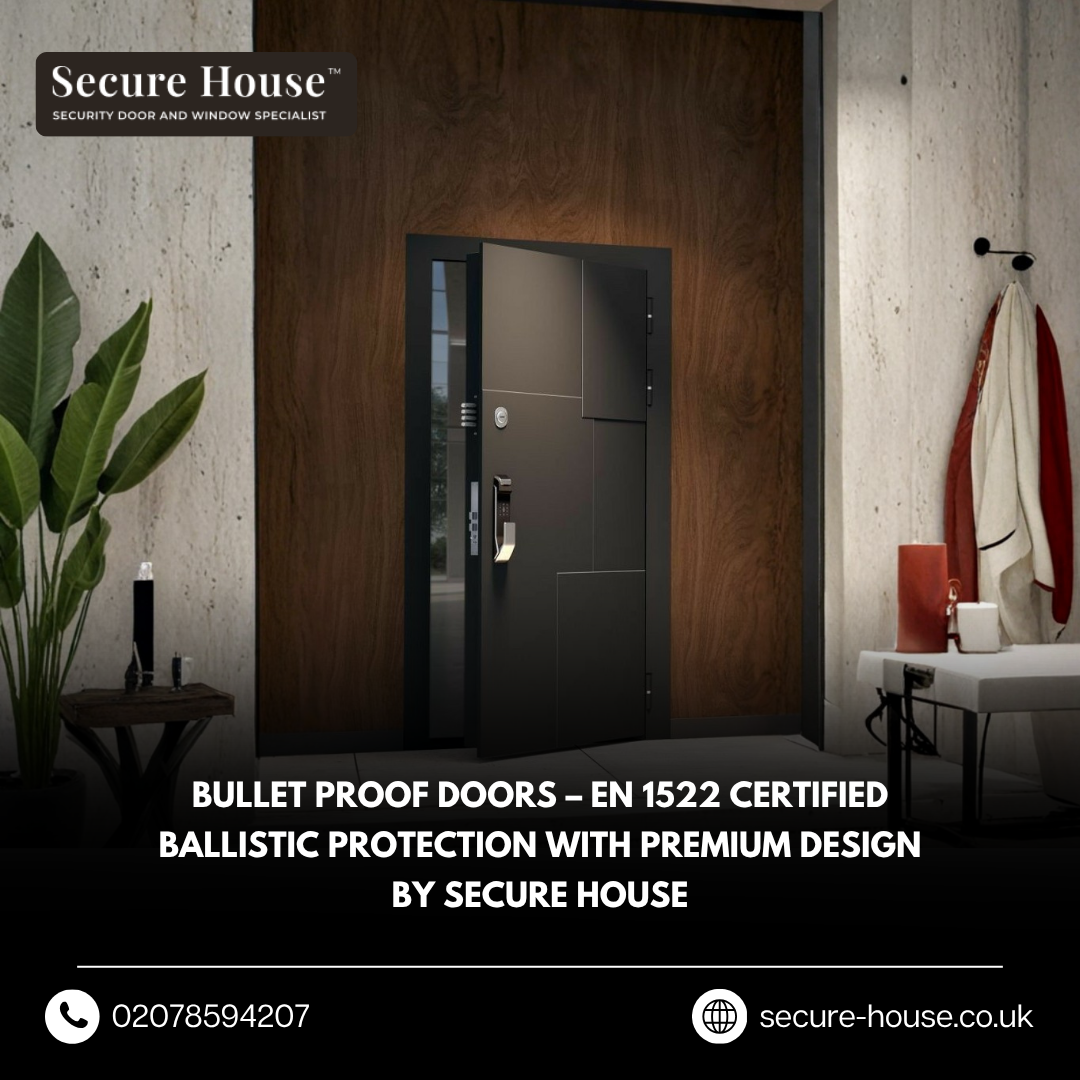
Bullet proof doors are doors built with layered steel or composite materials, ballistic glazing and reinforced frames and locks so that they resist gunfire up to a stated rating. The phrase is common in everyday use, but no door stops every threat, which is why bullet resistant doors is the more accurate term. The protection level is defined by the rating, the tested configuration and the quality of installation.
This guide explains how these doors work, how ballistic ratings are described, where they are used and what to weigh before specifying one.
What are bullet proof doors and how do they work?
Bullet proof doors work by absorbing and spreading the energy of a projectile across layers of material so it does not pass through. The usual construction combines a ballistic steel or composite core, a reinforced leaf, a strengthened frame and hinges, and ballistic glazing where a vision panel is needed. Many bulletproof doors also include burglary-resistant features such as multi-point locks.
The terms bulletproof and bullet resistant describe the same products. Because any door has a limit, a rated door is described by what it was tested against rather than by an absolute claim.
How are ballistic protection doors rated?
Ratings come from standardized tests that fire specified ammunition at a door set under controlled conditions. Several systems are in use. In Europe, EN 1522 classifies doors, shutters and blinds as FB1 to FB7, and ballistic glass is classified separately under its own standard. US-style levels, such as Level I to Level V, are also widely referenced.
Secure House describes its ballistic options on its security levels page:
Option
What Secure House states
RC4 + FB4
FB4 certified to EN 1522 with a ballistic steel core, protecting against handgun rounds up to .44 Magnum, and BR4-certified glass
RC4 + FB6
FB6 certified to EN 1522 with a hardened steel armour core, described as withstanding rifle rounds from 5.56x45 mm and 7.62x51 mm NATO, and BR6 glazing
The Secure House bullet proof doors page also lists a US-style table of Levels I to V. Because the naming differs between systems, always confirm which standard applies, the exact ammunition tested and the shot pattern used, and request the test report.
Where are bullet proof doors used?
Ballistic protection doors are used where there is a realistic risk of armed attack. Secure House lists these among its applications:
Embassy and government buildings.
Jewellery shopfronts and retail premises with high-value stock.
Police stations, court buildings and holding rooms.
Train stations and other public facilities.
Office buildings and areas used for hazardous goods.
Safe rooms within residential properties.
In homes, ballistic doors are most often considered for a safe room or panic room. Secure House offers panic room doors for this purpose.
Bullet resistance and burglary resistance are different
A door tested against bullets is not automatically tested against crowbars, drills and axes, and the reverse is also true. A ballistic rating such as FB4 or FB6 measures the response to firearms. A burglary class such as RC4 measures resistance to manual attack tools. Secure House combines the two in its RC4 + FB4 and RC4 + FB6 options, which is a useful model: check the certificate for both, not just one.
What should you consider before choosing a ballistic door?
Factor
Why it matters
Threat assessment
The rating should match the realistic threat, and over-specifying adds weight and complexity
Rating and standard
Different systems use different names and test ammunition
Whole assembly
The frame, glazing, hinges, locks and surrounding wall must all match the door's rating
Burglary resistance
Ballistic and burglary protection are separate; ask for both where needed
Weight and structure
Heavy doors need strong frames, hinges and fixings, and a suitable opening
Fire and escape
Some bullet resistant doors can be fire-rated; confirm exit and escape needs
Appearance and use
Finishes, handing, glazing and access control should suit daily operation
Inspection
Frames, hinges and locks need regular checks and manufacturer guidance
Are bullet proof doors impenetrable?
No. Secure House itself states that bulletproof doors are highly resistant to gunfire but not entirely impenetrable, and that the level of protection depends on the rating. Protection is limited to the tested threats, and damage from repeated hits or heavier ammunition can exceed the rating.
Common mistakes when specifying bulletproof doors
Focusing on the leaf while leaving the frame, wall or glazing at a lower rating.
Relying on a general description instead of a specific standard and class.
Confusing ballistic ratings from different systems.
Ordering a high rating for a modest threat, or the reverse.
Forgetting fire, escape and access needs.
Choosing bespoke finishes before confirming how they affect the rating.
Getting advice on ballistic doors
A site survey helps establish the structure, opening size, threat level and compliance needs. Work with a supplier who can show test evidence for the exact configuration, and who can explain which parts of the building need upgrading. Learn more about the company on the about us page, or discuss a project through the contact page.
Frequently Asked Questions
What is the difference between bulletproof and bullet resistant?
They refer to the same products. Bullet resistant is the more precise term, because no door is proof against every threat. A rated door is protected against the ammunition it was tested with.
What does FB4 mean on a door?
FB4 is a ballistic class under EN 1522. Secure House describes FB4 as protection against handgun rounds up to .44 Magnum. FB6 is a higher class, described by Secure House as covering certain rifle rounds.
Can a house have a bullet resistant front door?
Yes, though it is uncommon. Bullet resistant doors are more often specified for safe rooms in homes, with burglary-resistant front doors used on the main entrance. Match the rating to a real threat.
Do bullet proof doors also resist burglary?
Not automatically. Ask for burglary certification such as RC4 as well as the ballistic rating. Secure House combines both in its RC4 + FB4 and RC4 + FB6 options.
Is the glass bullet resistant too?
Only if ballistic glazing is specified. Secure House lists BR4 and BR6 glass with its FB4 and FB6 options. The glass rating should match the door's.